


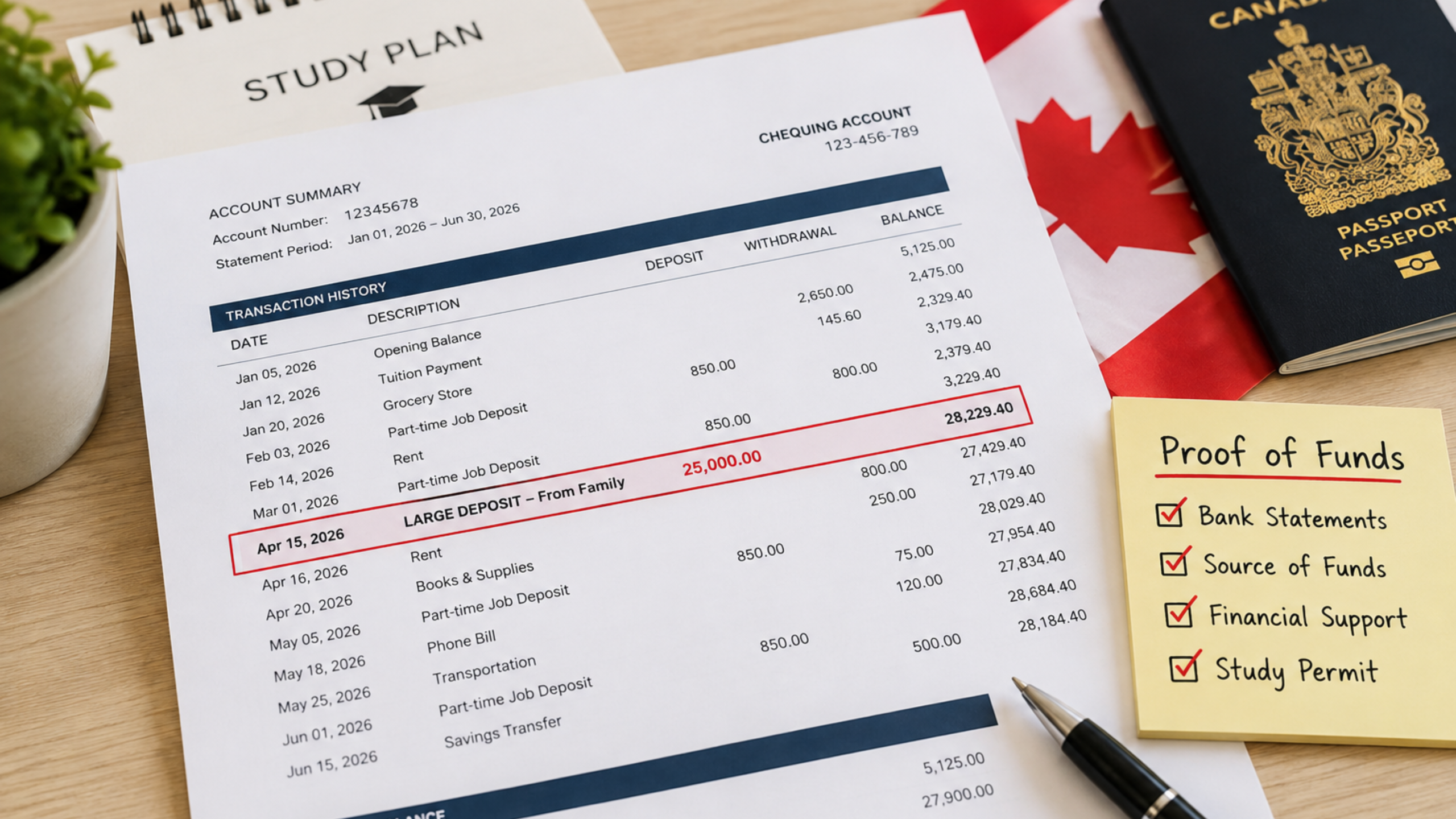

If you are preparing a Canadian study permit application, Canada proof of funds requirements just became something you need to pay closer attention to. On July 24, 2026, Immigration, Refugees and Citizenship Canada (IRCC) updated its officer guidance for assessing study permit applications. The update puts greater emphasis on both the amount of money an applicant has and the source of that money.
So while you still need to show that you have enough money to support yourself in Canada, simply having the required amount in your bank account may not be the end of the conversation. An officer may also look more closely at your financial history and, where necessary, consider additional financial or employment documentation.
That matters if your account contains large deposits, recently transferred funds or other transactions that need explanation. The good news is that the minimum living-expense amount has not increased because of this update.
For one person studying outside Quebec, the current amount is CAD $22,895 for one year of living expenses, in addition to tuition and transportation costs. So what exactly changed?
And what does it mean for your Canada proof of funds? Let’s break it down.
What changed in Canada’s proof of funds rules?
The biggest change is the increased focus on the source of funds. The updated IRCC officer guidance directs officers to assess both the amount and source of funds when considering a study permit application.
This is important because proof of funds has often been treated as a simple numbers exercise. You calculate the required amount, put the money in an account and provide your bank statements. The updated guidance makes the financial picture more important.
An officer may need to determine whether the funds are genuinely available to the applicant and whether the applicant has the financial capacity to support their studies without relying on work in Canada. Where necessary, officers can also consider additional financial and employment documents.
In practical terms, your application should be able to answer four questions:
- How much money do you have?
- Where did the money come from?
- Can you document the source?
- Is the money genuinely available to support your studies?
That is the biggest takeaway from the 2026 update. Canada still cares how much money you have. But now, the source of that money matters too.
Canada proof of funds rules: What changed in July 2026?
Here is a quick summary of the changes in the updated officer guidance:
| Financial issue | What the updated guidance says |
|---|---|
| Amount of funds | Officers assess the amount and source of funds |
| Bank statements | Officer guidance points to six months, including the application month or the month immediately before |
| Additional documents | Financial and employment documents may be considered where necessary |
| Rental income | Added as an example of financial support |
| Pension income | Added as an example of financial support |
| Convertible bank drafts | Removed from the examples of proof of funds |
| Study permit renewals | Financial capacity assessed against the first year following the extension |
| Minimum living expenses | CAD $22,895 for one applicant outside Quebec — unchanged |
There is an important detail about bank statements that applicants should understand. IRCC’s public proof of financial support guidance currently lists four months of bank statements among its common examples of proof of funds.
The July 24 officer guidance, however, points officers toward six months of statements, including the month of application or the month immediately before it. Some IRCC visa-office checklists already request six months of bank statements.
For that reason, applicants should always check the instructions that apply to their specific application rather than relying on an old checklist or advice from another applicant.
Why does the source of your funds matter?
Imagine two students applying for a Canadian study permit. Both have CAD $40,000 in their bank accounts. On paper, they both appear to have enough money. But their financial histories are completely different.
Student A has maintained a consistent balance and can document the money through savings, employment income and family support. Student B had CAD $5,000 in the account for several months and then received a CAD $35,000 deposit shortly before applying.
The amount is the same. The financial story is not. This is why your Canada proof of funds should not be treated as simply a bank balance.
The question is not only: “Do I have enough money?”
It is also: “Can I explain where the money came from?”
The updated guidance gives officers greater direction to assess the source of funds and consider additional financial or employment documents where necessary. That does not mean every large deposit will lead to a refusal. It means you should be prepared to explain significant or unusual transactions with appropriate documentation.
Does IRCC now require six months of bank statements?
This is one of the biggest questions surrounding the new Canada proof of funds rules. The updated July 2026 officer guidance points to six months of bank statements, including the month of application or the month immediately before it.
However, IRCC’s public financial-support webpage still lists four months of bank statements among its examples of proof of funds. That distinction matters.
It would be inaccurate to simply tell every applicant: “IRCC now requires six months of bank statements.”
The more precise explanation is that the updated officer guidance points to six months, while the public financial-support page continues to list four months among its examples. Your specific visa-office instructions may also request six months.
What should you do?
If you are preparing an application, start organizing your financial records well before you submit. A longer financial history gives you more time to identify significant transactions and gather documentation that explains them. This is especially useful if your funds come from several different sources.
Will a large bank deposit hurt your study permit application?
Not automatically. A large deposit is not, by itself, evidence that an applicant is financially ineligible. The important question is whether you can demonstrate the legitimate source of the money.
For example, a significant deposit could come from:
- The sale of a property
- Employment income
- Business income
- Rental income
- Pension income
- An education loan
- A scholarship
- Family support
- A documented gift
- Investment proceeds
The supporting documents you need will depend on the actual source of the money. What you should avoid is assuming that your bank statement explains everything. A bank statement can show that money entered the account. It may not explain why it entered the account. If a large amount was deposited shortly before your application, keep documentation that establishes its source.
For example, if the money came from the sale of property, keep the relevant sale documentation. If it came from employment or business income, keep the appropriate income records. Your goal is not to make your bank statement look perfect. Your goal is to make your financial situation clear, credible and documentable.
What does the Auditor General’s report have to do with Canada proof of funds?
The 2026 proof of funds update comes at a time when Canada’s international student program is facing increased scrutiny. The Office of the Auditor General of Canada’s March 2026 report found that IRCC had flagged more than 153,000 international students as potentially non-compliant between 2023 and 2024.
However, the department had funding to investigate only around 2,000 cases per year. The report also highlighted problems around financial documentation. In a sample of 51 study permit applications refused for insufficient funds, the Auditor General found that IRCC expected documentation in 23 cases that was not clearly outlined in the applicant instructions.
Some of those cases involved lump-sum deposits. That finding is important for anyone preparing a study permit application. It demonstrates why applicants should not think about financial documentation only in terms of reaching a minimum balance. Your application should also be able to explain how your education will actually be financed.
What counts as proof of funds for a Canada study permit?
IRCC provides several examples of documents that can demonstrate financial support.
Depending on your circumstances, these can include:
- Proof that you paid your tuition and housing
- A Canadian bank account in your name
- A Guaranteed Investment Certificate (GIC)
- A student or education loan
- Bank statements
- A letter from the person or institution providing you with money, together with other proof of funds
- Proof of financial support from within Canada
- Other documents demonstrating sufficient financial resources
The updated officer guidance also specifically includes rental income and pension income among the examples of financial resources that can be considered. The important thing is to choose documentation that reflects your actual financial situation.
If your parents are funding your studies, for example, your financial documentation should make that relationship clear. If you are funding yourself, your income and savings should be appropriately documented.
If you are using a combination of savings, family support, a loan and other resources, your documents should make that financial plan understandable. There is no benefit in creating a complicated financial story when a straightforward one can be properly documented.
Can rental income be used as proof of funds?
Yes. Rental income has been added to the updated officer guidance as an example of financial resources that may support a study permit application. This can be relevant where an applicant or sponsor receives consistent income from property.
For example, if a parent is helping to finance a student’s education using rental income, the applicant should be prepared to demonstrate the source of that income where relevant.
The goal is to establish that the income exists and that the funds being used for the student’s education are genuinely available. Rental income should therefore be supported by appropriate documentation rather than simply appearing as unexplained deposits in a bank account.
Can pension income be used as proof of funds?
Yes. Pension income has also been added to the examples in the updated officer guidance. This may be particularly relevant to applicants whose education is being funded by a retired parent or another family member receiving pension income.
Again, the key issue is documentation. If pension income is part of your financial support, make sure the source and availability of that income can be demonstrated where necessary. A clear explanation of the financial arrangement is much stronger than simply showing money in a bank account without context.
What happened to bank drafts?
The updated officer guidance removed convertible bank drafts from its examples of proof of funds. This is another reason applicants should be careful with older immigration information.
A document that appeared on an older checklist or in an older blog post may not necessarily reflect the latest guidance. If you are preparing a study permit application in 2026, check the current IRCC instructions applicable to your application. Do not assume that something is still accepted simply because you saw it recommended in an older article.
How much proof of funds do you need for Canada in 2026?
The July 2026 update did not increase the minimum living-expense amount. For one person applying to study outside Quebec, the current minimum is: CAD $22,895 for one year of living expenses.
This amount is in addition to tuition and transportation costs. The amount increases according to the number of family members included in the application.
| Family size | Minimum annual living expenses |
|---|---|
| 1 person | CAD $22,895 |
| 2 people | CAD $28,502 |
| 3 people | CAD $35,040 |
| 4 people | CAD $42,543 |
| 5 people | CAD $48,252 |
| 6 people | CAD $54,420 |
| 7 people | CAD $60,589 |
| Each additional person | CAD $6,170 |
If you are studying in Quebec, different financial requirements apply.
Also remember that the living-expense requirement is not your total study budget. You still need to account for tuition and transportation. You can check the latest figures on IRCC’s official financial-support page before submitting your application.
Did Canada increase the proof of funds amount?
No. The CAD $22,895 living-expense requirement for one person studying outside Quebec has not increased because of the July 24 update. The major change is in the assessment of financial evidence, not the minimum amount itself. This distinction is important.
If you see a headline suggesting that Canada suddenly increased the proof of funds amount, check the actual IRCC requirements before assuming it is true. The July 2026 update is more about how financial evidence is assessed.
What changed for study permit renewals?
The updated guidance also affects students who are already in Canada and need to extend their study permits. For renewals, the student’s financial capacity is assessed against the first year following the extension.
In other words, an existing student should not assume that financial evidence is irrelevant simply because they have already received a study permit. If you are extending your permit, you still need to demonstrate that you have the financial resources required for the period being assessed. If you need to extend your study permit, review IRCC’s current study permit extension instructions before applying.
How should you prepare your Canada proof of funds?
The biggest practical lesson from the updated guidance is simple: Do not leave your proof of funds until the last minute.
Here are six steps you can take.
1. Start preparing your financial history early
If possible, begin organizing your financial records months before your intended application. This gives you time to identify unusual transactions and gather the necessary documentation.
2. Keep evidence for large deposits
If a significant amount of money enters your account, keep evidence showing where it came from. Do not wait until an officer asks for an explanation before you start searching for documents.
3. Document your sponsor’s finances
If your parents, spouse or another person is paying for your education, their financial situation may form an important part of your proof of funds. Do not focus only on their bank balance. Consider how you will demonstrate their income and ability to provide the support.
4. Do not borrow money simply to create a bank balance
Your objective should not be to make your account appear wealthy shortly before applying. Your objective is to demonstrate genuine, available funds that you can explain. If you borrow money, make sure you understand how that loan fits into your overall financial plan and what documentation is required.
5. Remember that tuition is separate
The CAD $22,895 living-expense figure is not the total amount you need for your studies. You also need to account for tuition and transportation. Your financial plan should reflect the actual cost of your education.
6. Check the latest IRCC instructions
Immigration requirements and officer guidance can change. Before submitting your application, check the current IRCC requirements and the instructions that apply to your country and application type.
What is the biggest mistake applicants make with proof of funds?
One of the biggest mistakes is treating proof of funds as a single number. An applicant sees the required amount, looks at their bank balance and assumes the financial requirement is complete. But a stronger application considers the bigger picture.
If you have the required funds, ask: Where did the money come from? Someone else is funding you? Ask: Can I document their ability to provide the money? If you recently received a large deposit, ask: Can I prove why I received it?
If your program lasts several years, ask: How will I finance the rest of my studies? These questions help you build a financial story that is easier to understand and support with documents.
What changed in Canada’s proof of funds rules in 2026?
On July 24, 2026, IRCC updated its officer guidance for assessing study permit applications. The update places greater emphasis on assessing both the amount and source of funds, with additional financial and employment documentation considered where necessary.
Does IRCC now require six months of bank statements?
The updated July 2026 officer guidance requires six months of bank statements, including the application month or the month immediately preceding it. However, IRCC’s public financial support page still lists four months as an example. Applicants should check the instructions applicable to their specific application and visa office.
How much money do I need for a Canada study permit in 2026?
For one person studying outside Quebec, the current minimum living-expense requirement is CAD $22,895 for one year. This is in addition to tuition and transportation costs.
Did Canada increase the proof-of-funds amount?
No. The July 2026 update did not increase the minimum living-expense amount for a single applicant outside Quebec. The important change is the greater emphasis on the source and documentation of funds.
Can a large bank deposit cause a study permit refusal?
Not automatically. A large deposit does not by itself mean an application will be refused. However, applicants should be prepared to explain and document significant deposits when necessary.
Can rental income be used as proof of funds for Canada?
Yes. Rental income has been added as an example of financial resources in the updated officer guidance. Applicants should be prepared to document the source and availability of the income where relevant.
Can pension income be used as proof of funds?
Yes. Pension income is also included as an example of financial resources in the updated officer guidance.
Are bank drafts still accepted as proof of funds?
Convertible bank drafts were removed from the list of proof-of-funds examples in the updated officer guidance. Applicants should check the latest instructions applicable to their application.
Does the update apply to study permit renewals?
Yes. The updated guidance states that financial capacity for study permit renewals is assessed against the first year following the extension.
Do I need enough money for my entire study program?
You must demonstrate sufficient financial resources for your first year. If your program lasts longer than one year, you should also explain how you plan to finance your studies for the full duration.
The Bottom Line
The July 2026 update does not mean Canada has stopped caring about how much money you have. It means that Canada’s proof of funds is becoming less about showing a number and more about demonstrating a credible financial picture.
Think about your application this way: How much money do you have? Where did it come from? Can you prove it? Is it genuinely available to support your studies?
If the answers are clear, your financial documentation is much stronger. So if you are planning to study in Canada, do not wait until you receive your admission letter before thinking about proof of funds. Start preparing your financial records early. Keep documentation for significant transactions. Make sure your sponsor’s finances are properly documented. And do not move money around simply to make your bank balance look better.
The amount still matters. But in 2026, the story behind the money matters too.
If you’re unsure whether your financial documents tell a clear and credible story, book a study permit consultation with CanadaImmHub before submitting your application.
Sources and Further Reading
- IRCC: Proof of financial support — Current financial requirements and examples of proof of funds.
- IRCC: Study permit — Study permit application information.
- IRCC: Extend your study permit — Information for students extending their permits.
- Office of the Auditor General of Canada: International Student Program Reforms — March 2026 report on Canada’s international student program.
Immigration policies and officer instructions can change. Always check the latest IRCC requirements applicable to your individual circumstances before submitting an application.
