


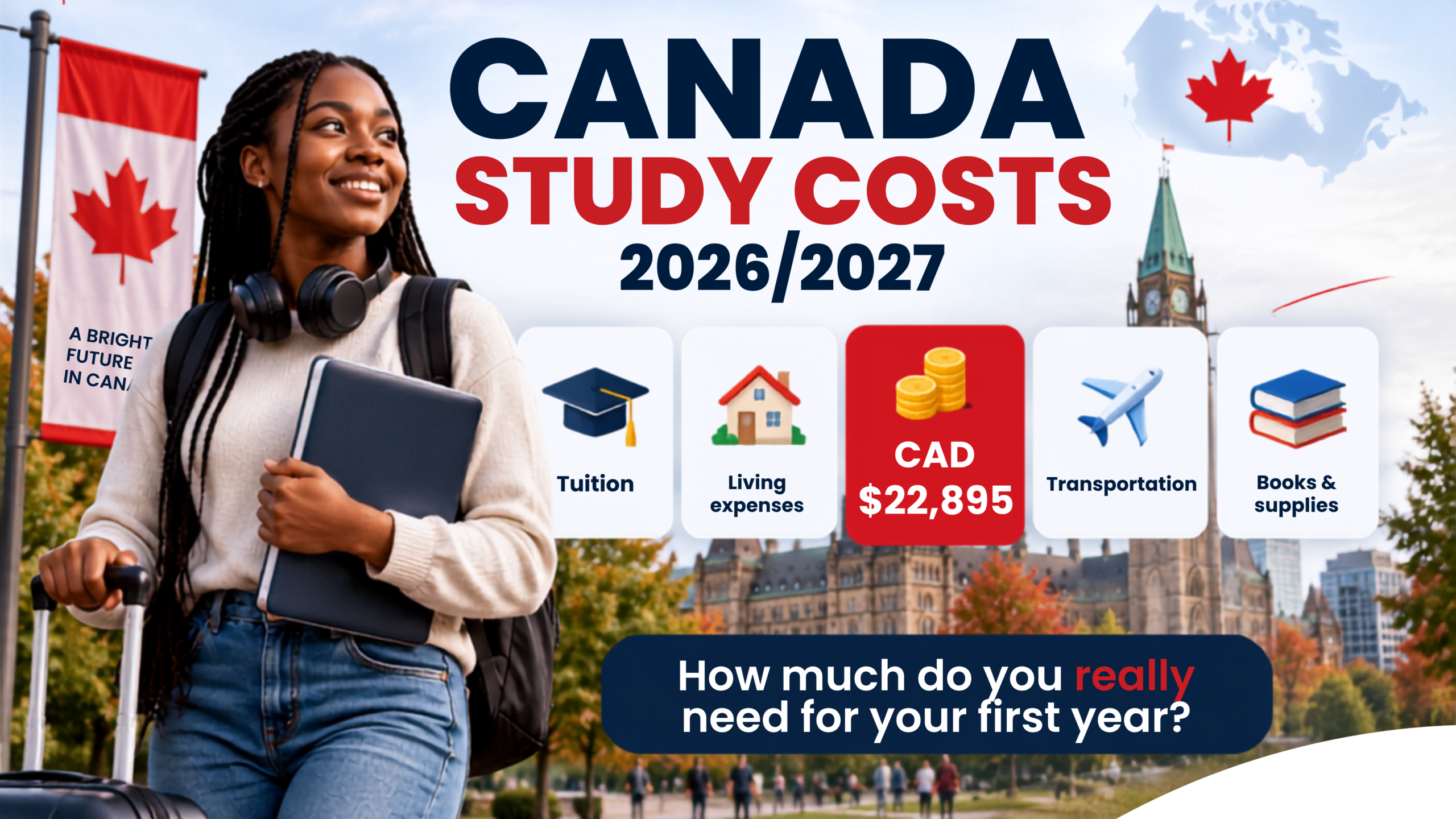

If you’re researching the cost of studying in Canada in 2026, tuition is probably the first number you’ve looked at. But tuition is only one part of what you need to budget before you move.
You also need to account for housing, food, transportation, health insurance, books, flights and the money you need to demonstrate for your study permit. For 2026, a student applying for a study permit outside Quebec must show CAD $22,895 in living expenses for one year, separate from tuition and transportation.
So the useful question isn’t simply, “How much is tuition?” It is: “How much money will I actually need for my first year in Canada?”
This guide breaks down the cost of studying in Canada in 2026 into the expenses that matter, including tuition, living costs, proof of funds, accommodation, transportation and the costs students often forget to plan for.
Quick answer: Your first-year budget is generally the actual first-year tuition, plus CAD $22,895 in required living funds for one student outside Quebec, transportation, and other applicable costs. The CAD $22,895 figure is the federal living-expense requirement; it
is not your total study budget.
What makes up the cost of studying in Canada in 2026?
There is no single price for studying in Canada. Your total depends on your programme, school, province, city and personal circumstances. Think about your budget in these categories:
- Tuition: what your school charges for the programme
- Living expenses: rent, food, transportation and daily life
- Study-related costs: books, supplies, technology and other
programme expenses - Travel: your flight and transportation to your accommodation
- Settlement costs: deposits, household items and other expenses
when you first arrive - Financial requirement: the amount you must demonstrate to IRCC
for your study permit application.
IRCC requires applicants to show sufficient funds, without relying on work in Canada, to cover tuition, living expenses and transportation. For programmes longer than one year, you must also explain how you plan to fund the full duration of your studies.
How much is tuition for international students in Canada?
Canadian tuition fees vary depending on your school, province, course of study, and level of study. Statistics Canada reports the following 2025/2026 national averages:
- International undergraduate tuition: CAD $41,746
- International graduate tuition: CAD $24,028
Provincial averages also vary significantly. For example, average international undergraduate tuition in 2025/2026 was CAD $18,867 in Newfoundland and Labrador, CAD $21,424 in Manitoba, CAD $34,880 in Alberta and CAD $49,802 in Ontario.
These are averages, not guaranteed prices for your programme.
For graduate students, the 2025/2026 provincial averages ranged from CAD
$6,964 in Newfoundland and Labrador to CAD $28,624 in Ontario. The best way to budget is to use the actual tuition quoted by your
institution.
What other costs should you budget for When calculating cost of studying in Canada in 2026?
The IRCC living-expense figure is a financial requirement, not necessarily your actual spending.
You should also budget for:
- Rent or student residence
- Food and groceries
- Local transportation
- Health insurance
- Books and supplies
- Phone and internet
- Clothing and winter gear
- Personal expenses
- Initial settlement costs
- Emergency savings
The Government of Canada notes that health coverage for international students
varies by province and that schools can provide insurance information.
What would a first-year cost of studying in Canada in 2026 look like?
Use your actual tuition and then add the IRCC amount.
Example: CAD $18,000 tuition
- Tuition: CAD $18,000
- Living requirement: CAD $22,895
- Transportation: additional
- Other setup costs: additional
Starting point: CAD $40,895 + transportation and other costs.
Example: CAD $25,000 tuition
- Tuition: CAD $25,000
- Living requirement: CAD $22,895
- Transportation: additional
Starting point: CAD $47,895 + transportation and other costs.
Example: CAD $40,000 tuition
- Tuition: CAD $40,000
- Living requirement: CAD $22,895
- Transportation: additional
Starting point: CAD $62,895 + transportation and other costs.
These are planning examples, not a universal bank-balance requirement.
Do you need all the money in one bank account?
No, not exactly. IRCC lists several types of financial evidence, including:
- Bank statements
- A Canadian bank account in your name
- A Guaranteed Investment Certificate (GIC)
- A student or education loan
- Scholarship documentation
- Proof of tuition or housing payments, together with evidence of
sufficient remaining funds - A letter from the person or institution providing financial support,
supported by proof of funds
IRCC also lists bank statements covering the past six months as one
possible form of evidence.
Can your parents sponsor your studies?
Yes. A parent can be part of your financial support plan. The important part is making the financial story clear:
- Who is paying?
- Where did the money come from?
- How much are they contributing?
- What costs will it cover?
- How will the remaining costs be funded?
A large unexplained deposit is not a substitute for a credible financial history.
Can a scholarship reduce the amount you need?
Yes. IRCC accepts scholarship and other financial support documentation as evidence. If the scholarship covers only tuition, you still need to demonstrate how you will cover living expenses and transportation.
Can you work in Canada to pay for school?
Eligible international students can work, subject to their study permit conditions and Canada’s current rules. However, your initial financial plan should not depend on future employment. IRCC requires applicants to demonstrate enough funds without relying on work in Canada.
Does the amount change if your family comes with you?
Yes. The living-expense requirement increases with the number of family
members accompanying you. For example, outside Quebec:
- 1 person: CAD $22,895
- 2 people: CAD $28,502
- 3 people: CAD $35,040
- 4 people: CAD $42,543
You also need to consider the family’s transportation, accommodation, food, insurance and other costs.
How can Nigerian students reduce the cost of studying in Canada in 2026?
If your budget is limited:
Compare provinces: Average tuition and housing costs differ across Canada.
Compare programmes: Two programmes at the same level can have very different tuition fees.
Also compare cities: A lower tuition fee does not necessarily mean a lower overall cost if housing is much more expensive.
Consider shared accommodation: Sharing housing can reduce your monthly expenses.
Look for scholarships: Check your institution and relevant scholarship sources.
Budget for the whole first year: Do not budget only for tuition and the visa. Include housing, food, transport, insurance, books, flights and settlement costs.
How much money should you have before applying?
There is no universal bank-balance number. Use this formula:
First-year tuition + applicable living-expense requirement + transportation + realistic additional costs.
Then prepare evidence showing where the money comes from and how you will fund the remainder of the programme.
What is the cheapest province to study in Canada?
There is no single answer for every programme. For 2025/2026, Newfoundland and Labrador had the lowest average international undergraduate tuition among the provinces listed by Statistics Canada at CAD $18,867. New Brunswick and Manitoba were also below the national average.
But tuition is only one part of the equation. Compare tuition, housing, transportation, and programme fit.
Frequently asked questions
How much money do I need to study in Canada in 2026? For one student outside Quebec, IRCC currently requires proof of CAD $22,895 in living expenses for one year, excluding tuition and transportation. You must also demonstrate that you can pay tuition and transportation.
Is CAD $22,895 enough to study in Canada? No. It is the current one-person living-expense requirement outside Quebec. It does not include tuition or transportation.
How much does university cost in Canada for international students? For 2025/2026, Statistics Canada reports average international tuition of CAD $41,746 for undergraduate students and CAD $24,028 for graduate students. Actual fees vary.
Can I use my parents’ bank account as proof of funds? Financial support from another person can be used, but you need documentation showing the relationship, the source, and the availability of the funds. Follow the current IRCC and country-specific instructions.
Can I use a scholarship as proof of funds? Yes. Scholarship and other financial-support documentation can be used as evidence.
Can I work in Canada to fund my studies? Eligible students can work subject to Canadian rules, but you must demonstrate sufficient funds without relying on work in Canada for the initial requirement.
Final thoughts on cost of studying in Canada in 2026?
There is no magic bank-balance number for studying in Canada. Start with your actual tuition. Add the current IRCC living-expense requirement. Add transportation and the costs your specific city and programme will create.
Then ask the bigger question: How will I fund the rest of my programme?
That is a much stronger way to plan your study-abroad journey than by looking up a single number online.
Not sure if your finances meet IRCC’s current requirements? Book a free consultation with us here, and we’ll review your tuition, proof of funds, and documentation before you submit, so you’re not guessing about a $22,895+ decision.
